
Mr. Chen (pseudonym), 66 years old, experienced dull pain in the right upper abdomen after eating greasy food. Within a few days, the pain worsened dramatically and radiated to his back and right shoulder. He subsequently developed chills and a high fever (with a peak temperature of 40°C), accompanied by jaundice of the skin and sclera, and urine that was dark yellow, resembling strong tea.
A CT scan at a local hospital revealed diffuse stones in the gallbladder, common bile duct, and intrahepatic bile ducts, atrophy of the left lobe of the liver, and cystic dilation of the common bile duct. The condition is not simply gallstone disease; the underlying “culprit” isCongenital cystic dilation of the bile ducts (Todani Type IVa)。
Congenital structural abnormalities
Long-term risk of cancer
The patient was transferred to the Department of Hepatobiliary Surgery at Kaiqiang Memorial Hospital, where he was admitted by Professor Shao Zili’s team. Further investigations, including CT, magnetic resonance cholangiopancreatography (MRCP), and liver function tests, revealed that the patient presented with marked jaundice, elevated total and direct bilirubin levels, and significantly elevated transaminases and white blood cell count. Imaging studies revealed multiple stones in the distal common bile duct and the left intrahepatic bile ducts, leading to secondary acute obstructive cholangitis. Congenital cystic dilatation of the common bile duct causes structural abnormalities in the biliary tract and impaired bile drainage. This, combined with recurrent stone formation and biliary tract infections, constitutes a high-risk factor for the development of cholangiocarcinoma.
Professor Shao Zili pointed out:“Type IV choledochal cysts complicated by long-standing stones and cholangitis carry a significantly increased risk of malignancy. Furthermore, the atrophy and loss of function in the left hepatic lobe constitute a potential site for infection and malignancy. The indications for surgery are clear, and the procedure should be performed as soon as possible.”
Multidisciplinary Team (MDT) Collaboration
Developing Individualized Surgical Strategies

Traditional surgical procedures require the complete resection of all dilated extrahepatic bile ducts, extending beyond the junction of the left and right hepatic ducts, to minimize the risk of malignancy. However, in this case, the patient also requires resection of the left extrahepatic lobe, making it necessary to address two complex anatomical regions: the hepatic hilum and the left hepatic lobe. If one were to insist on “complete resection” of the extrahepatic bile ducts, it would require meticulous dissection of the left and right hepatic ducts at the hepatic hilum, adjacent to the hepatic artery and portal vein; even the slightest misstep could lead to fatal hemorrhage. Following high resection, separate anastomoses must be performed between the left and right hepatic ducts and the intestine, which is technically challenging and carries a high risk of postoperative anastomotic ischemia, bile leakage, and long-term strictures.
In addition, the patient is a 66-year-old elderly individual with comorbidities including hypertension, type 2 diabetes, and bilateral pulmonary infection; the prolonged duration of surgery combined with the physical trauma will significantly increase perioperative risks.
Following in-depth discussions by a multidisciplinary team (MDT) comprising Professor Shao Zili from the Department of Hepatobiliary Surgery, Professor Wang Zhongyang from the Department of Urology, Professor Jiang Zongpei from the Department of Nephrology, Professor Chen Jianyu from the Imaging Center, Director Hu Yaohua from the Department of Surgery, Director Sa Rula from the Department of Internal Medicine, and Dr. Yang Peiyuan from the Department of Anesthesiology, an individualized, modified surgical plan was developed:
The goal is not to achieve complete anatomical resection, but rather to achieve functional cure. The procedure involves complete resection of the left hepatic lobe and the atrophic lesion, as well as removal of gallstones. Concurrently, the common bile duct and the hepatic duct are resected below the confluence of the left and right hepatic ducts, while preserving the confluence and a short segment of the structurally normal proximal portion. The residual bile duct is near-normal, presenting an extremely low risk of malignancy and facilitating long-term postoperative imaging follow-up. For gastrointestinal reconstruction, the preserved common hepatic duct—which has adequate lumen diameter and good blood supply—is used to perform a single-anastomotic common hepatic duct–jejunal Roux-en-Y anastomosis, thereby avoiding high-risk double anastomoses. This approach minimizes surgical trauma and the risk of complications while ensuring curative results.
Precise laparoscopic procedures
Intraoperative blood loss was only 400 milliliters
The surgery was performed under general anesthesia using a minimally invasive laparoscopic approach. Professor Shao Zili’s team carried out the procedure step by step according to the pre-determined plan:
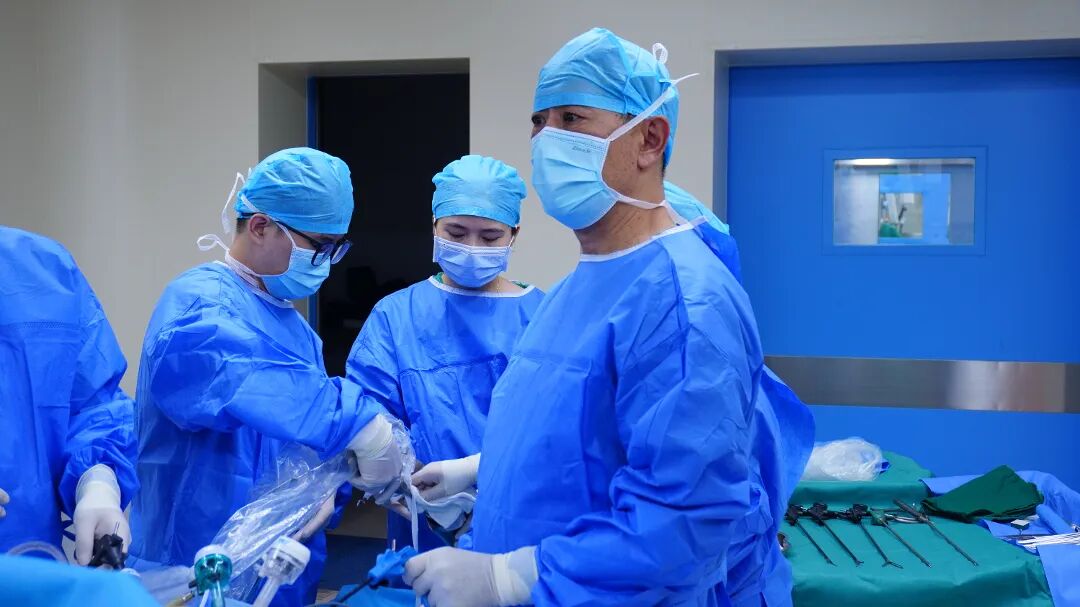
1. Resection of the left hepatic lobe:Using an ultrasonic scalpel, the ligaments surrounding the liver were dissected to expose the first hepatic portal. Blood flow to the liver was occluded, and the liver parenchyma was meticulously dissected along the ischemic margin to completely resect the atrophic left lateral lobe.
2. Cholecystectomy:In the gallbladder triangle, dissect the cystic duct and the cystic artery, clamp and transect them, and completely dissect the gallbladder.
3. Cystectomy and stone removal from the common bile duct:Thoroughly dissect the cystic dilated bile duct from the surrounding tissues, resect the distal and proximal segments, and remove the duct. Use a choledochoscope to examine the intra- and extrahepatic bile ducts, remove all stones using a stone retrieval basket, and repeatedly flush the area until no stones are visible under the scope.
4. Biliary-intestinal anastomosis and gastrointestinal reconstruction:Transect the jejunum, and perform an end-to-side anastomosis between the distal jejunum and the prepared common hepatic duct; perform a side-to-side anastomosis between the proximal jejunum and the distal jejunum to restore intestinal continuity.
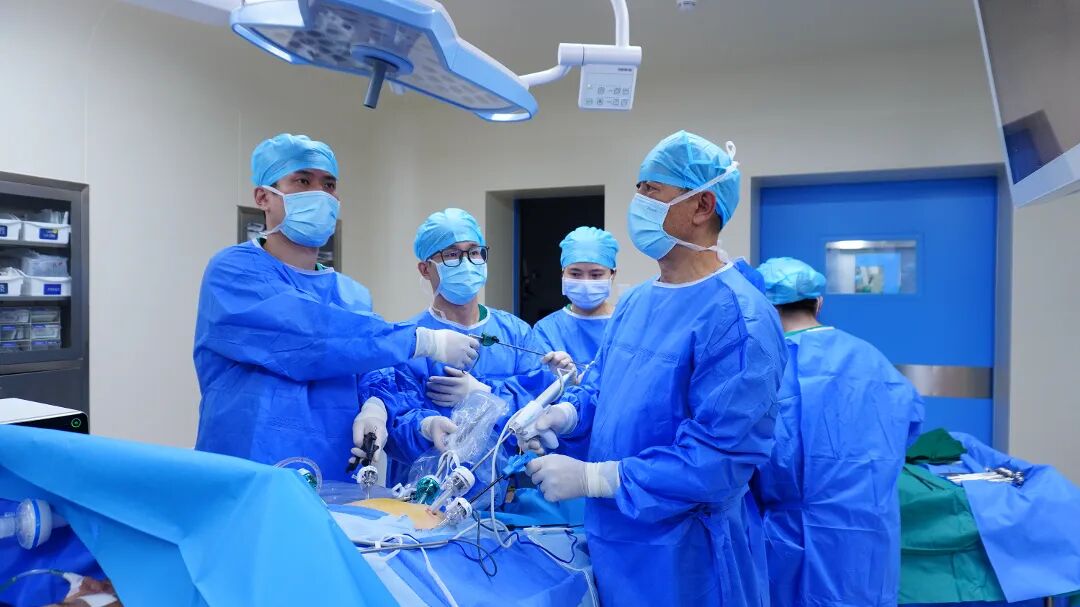
The surgery lasted more than five hours, with a total blood loss of approximately 400 milliliters. Postoperatively, the patient’s bilirubin levels and transaminase levels decreased significantly, approaching normal ranges by the time of discharge, and no complications such as postoperative bleeding or bile leakage occurred. Thanks to the minimally invasive nature of the procedure and meticulous perioperative management, the patient recovered smoothly and was discharged as scheduled. Follow-up visits are required only periodically to monitor long-term risks.
This case involved congenital cystic dilatation of the bile ducts (Todani Type IVa) complicated by intra- and extrahepatic bile duct stones, atrophy of the left lobe of the liver, and acute obstructive cholangitis, presenting a critical condition and posing significant surgical challenges. Through multidisciplinary collaboration, Professor Shao Zili’s team developed a personalized, functionally curative surgical plan and successfully performed lesion resection and biliary reconstruction using laparoscopic minimally invasive techniques. This fully demonstrates the technical expertise and mature diagnostic and treatment system of the Department of Hepatobiliary Surgery at Kaiqiang Memorial Hospital in managing complex, high-risk biliary diseases.


You can schedule an appointment with Professor Shao Zili at our hospital.
Professor Shao sees patients by appointment only. Please schedule an appointment in advance.
"To make a reservation, call 020-8307-0088"